
Five things the best andon systems have in common
Before comparing vendors, agree on what the system must do on your floor. These five criteria separate an andon that changes response times from one that only lights up.
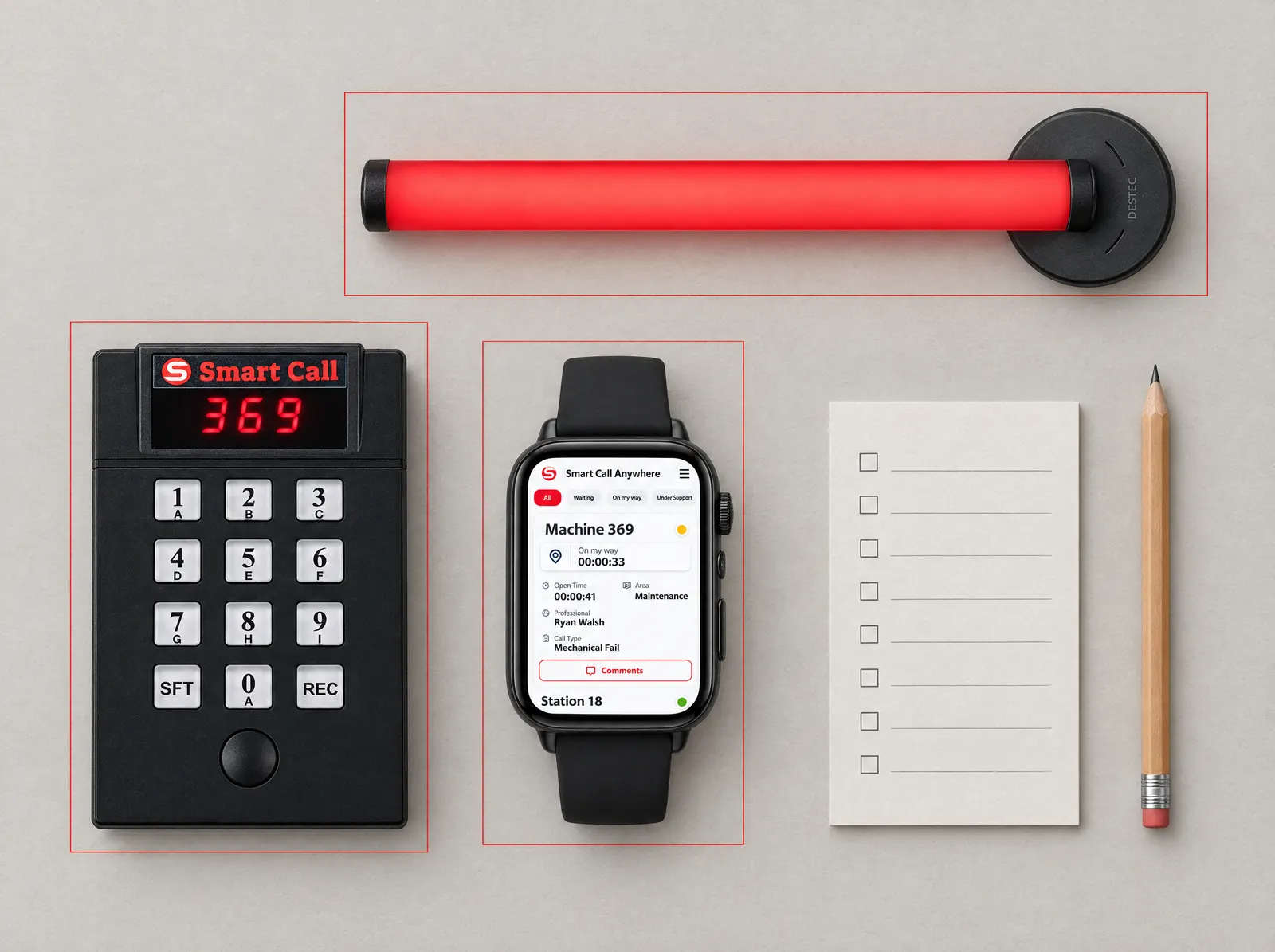
- One-press signal with a reason. Operators pick material, maintenance, quality or supervisor at the station, not a single generic alarm.
- Routing to a person. The call reaches the responsible person directly, on a watch or phone, instead of waiting for someone to notice a light.
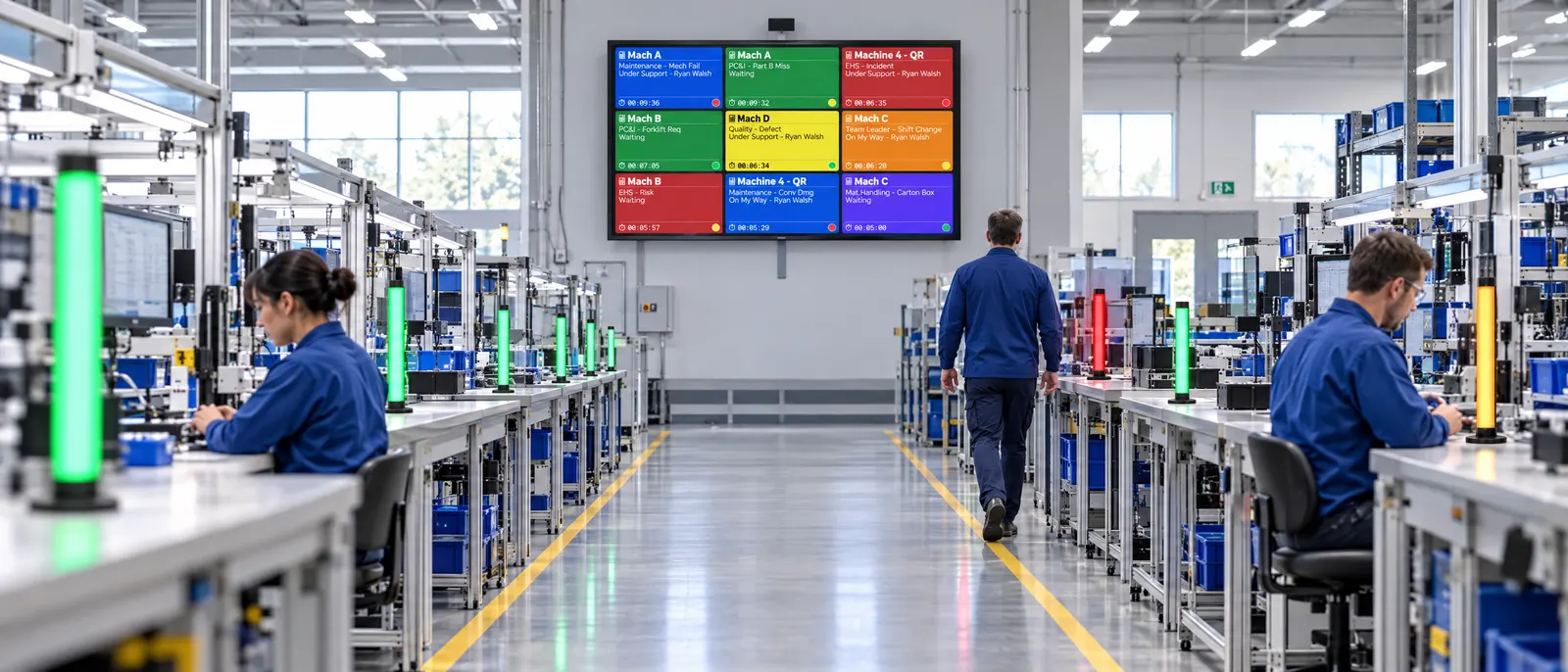
- Visibility for everyone. A light at the station and a board for the line, so supervisors see every open call and how long it has waited.
- Automatic records. Every call timed from press to response to fix, without spreadsheets, so you can see downtime, response and repair times.
- Easy to install and change. Stations move when the layout changes; a system that needs new cabling for every move gets left behind.
Wired, wireless, software-only or stack lights?
Andon comes in four common forms. Many plants combine them; what matters is whether the whole loop, signal, route, show and record, is covered.
| Type | What it does well | Watch out for |
|---|---|---|
| Wireless andon system | Call stations, lights, watches and a board with no cabling; routes each call to a person; records every stop. | Check that it covers every station in your building and works with your plant network. |
| Wired andon system | Fixed panels and lights hard-wired to each station. | Cabling to install, and again every time the layout changes. |
| Software-only / tablet andon | Buttons on a screen at each station, data in the cloud. | Needs a device and reliable Wi-Fi at every station; operators must unlock and tap. |
| Stack lights / tower lights only | Clear status at the machine, visible from across the floor. | A light nobody owns: no routing to a responder and no record of the stop. |
Why most plants now choose wireless andon
Wireless andon removes the thing that slows projects down most: cabling. Stations can be mounted in minutes and moved when the line changes.
Wired systems still make sense where a panel is already installed and the layout never changes. If you are starting fresh or your lines move, wireless is usually faster to install and easier to live with.
What drives andon system cost
Andon pricing depends on what you put on the floor. Rather than a list price, count these items for the first line you want to cover:
- Number of stations (call station keypads or buttons)
- Number of light bars or stack lights
- Number of people who respond (watches or app users)
- Number of boards (TV screens) per line or area
- Analytics (downtime and response-time reports) and support
- Purchase or lease, and installation
How andon implementation works
A wireless andon rollout is short when the scope starts small. A typical sequence:
- Week 0Pick one line and agree the call reasons (material, maintenance, quality, supervisor) and who owns each one.
- Day 1Mount keypads and light bars at the stations, place the board, pair the watches. No cabling.
- Week 1Operators and responders use it on every shift; small adjustments to reasons and routing.
- Week 2–4Review downtime, response and repair times by station and shift; fix the biggest causes.
- Day 30Decide with your own data: expand to more lines, or stop.
Questions to ask any andon vendor
- Who gets the call, a light, a board or a specific person?
- Will it cover every station in our building, and what does it need from our network?
- How long does installation take, and what happens when a station moves?
- What is recorded automatically, and can we see response and repair times separately?
- Can we start on one line before committing to the plant?
- Who supports it, and when?